
From Interest to Departure: What the 2026 Mobilization Report Shows
Every mobilizer knows the gap between a full inbox of interested candidates and the much smaller group that actually departs. The 2026 Mobilization Report, Volume…
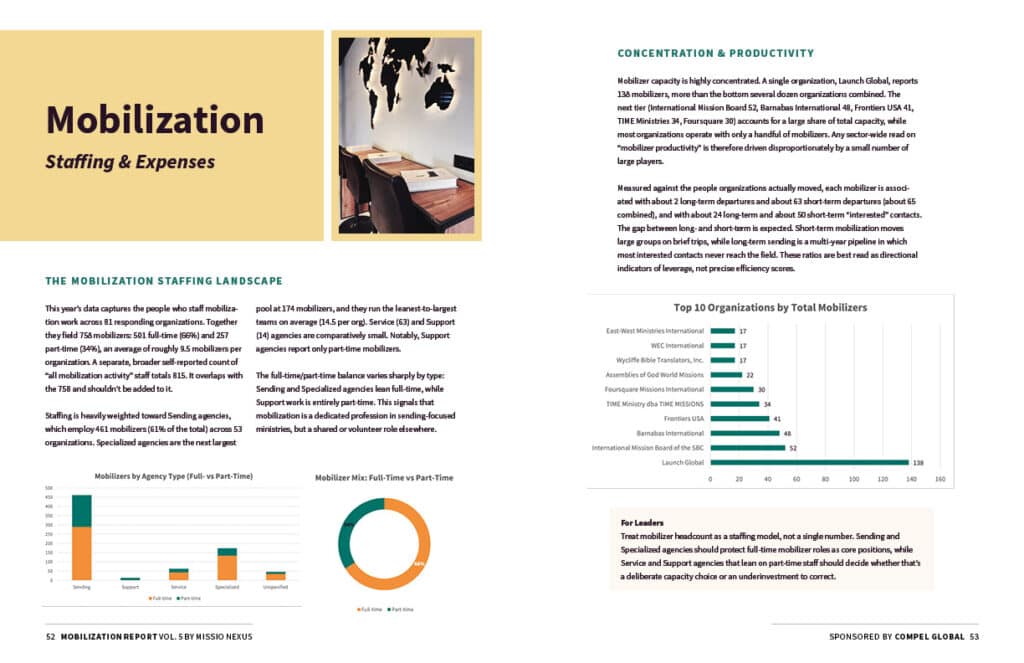
Every mobilizer knows the gap between a full inbox of interested candidates and the much smaller group that actually departs. The 2026 Mobilization Report, Volume 5, puts numbers on that gap. It draws on 2025 year-end data from 81 North American mission organizations and follows the long-term missionary pipeline one stage at a time.
The headline counts are 17,882 newly interested candidates, 3,408 applicants, 1,925 pre-field workers, and 1,503 long-term departures. Dividing each stage by the one before it gives a rough picture: about 19 percent of interested candidates became applicants, about 56 percent of applicants reached pre-field status, and about 78 percent of pre-field workers departed. The steepest drop comes at the very start of the journey. These are year-end totals for each stage, not a single group of candidates followed through, so read the percentages as a sketch and not as conversion rates. The report gives the participating organizations’ own rates at every step.
Volume 5 adds three new benchmarks: how long candidates stay in each pipeline stage, applicant age ranges, and mobilization budgets and spending priorities. Open responses from agencies describe what is working now, from candidate coaching and church partnerships to Gen Z engagement and short-term pathways.
The full report runs 53 pages and includes short-term mobilization across three service bands, comparisons by agency type, and agency-by-agency tables. It is free to participating organizations, $50 for Missio Nexus members, and $150 for non-members. Get the full report to benchmark your own pipeline.
The 2026 Mobilization Report was made possible by Compel Global.
 Book ReviewsSlow Theology: Eight Practices for Resilient Faith in a Turbulent World (A Guide to Deep Faith in our Busy Modern Lives) November 17, 2026
 ArticleSo What Do We Do? Questions for Your Board and Your LeadersNovember 11, 2026
 Book ReviewsWe Will Be Changed: 9 Inner Glories the Spirit Is Cultivating in You November 10, 2026