The Past and Future of Funding Missions: From Everywhere to Everywhere – National Workers vs. Missionaries
By Scott Klingsmith | The direct support of national pastors and missionaries by American and European churches has been promoted as a more efficient and effective model of ministry than sending missionaries from the West to other parts of the world. After a historical overview of funding models and a survey of current missionary funding models, I explore the various pros and cons of direct support of national pastors and missionaries, with or without the mediation of American missionaries or agencies.
EMQ » April – May 2026 » Volume 62 Issue 2
Summary: The direct support of national pastors and missionaries by American and European churches has been promoted as a more efficient and effective model of ministry than sending missionaries from the West to other parts of the world. After a historical overview of funding models and a survey of current missionary funding models, I explore the various pros and cons of direct support of national pastors and missionaries, with or without the mediation of American missionaries or agencies.
By Scott Klingsmith
Support for national workers has been seen by many, both in the West and in the Majority World, as a solution for the declining numbers and increasing cost of Western missionaries. I became interested in this topic after hearing reports of an American pastor teaching an evangelism course at a leading seminary. According to students, he was actively discouraging them from personal involvement in missions. Instead, he promoted a missions strategy based solely on supporting national workers. This got me wondering whether this was an idiosyncratic view of one pastor or whether the idea was more widespread.
As global churches grow and Western missionary numbers plateau, many American congregations face the question: “Should we send expensive expatriates, or should we channel resources to national workers? After all, local workers already speak the language, know the culture, and live at a fraction of the cost.
To gain insight into the question, I interviewed seven mission pastors of US churches who support national workers as part, or all, of their mission funding strategy. In this article, I articulate some of the opportunities and challenges of this approach. I begin by briefly surveying the history of missionary funding, summarizing key insights from the growing literature on partnership. I follow this with practical guidance for churches and national workers across the globe.
The Past – Missionary Funding throughout History
Mission funding has never been one-size-fits-all. A historical sweep reveals a wide variety of models—many of which continue today.
The earliest missionaries were ordinary believers scattered by persecution. Acts records those who fled Jerusalem “preached the word wherever they went” (Acts 8:4). Traders along the Silk Road, soldiers stationed far from home, and refugees of every sort carried the gospel with them. These were tentmakers in the purest sense. They supported themselves through their trades and shared Christ in the normal rhythms of life. This model still inspires modern “marketplace missionaries,” though language barriers and visa regulations make it more complex today.
The first intentionally sent missionaries that we are aware of were Barnabas and Paul. They were commissioned and sent by the church in Antioch (Acts 13). We don’t know how they were initially financed, but we get glimpses of their funding models throughout the New Testament. The apostle Paul sometimes supported himself as a tentmaker, and sometimes received gifts from churches like Philippi. Early itinerating teachers and missionaries relied on the hospitality of local believers but rarely drew a regular salary.[i]
As Christianity moved outward, methods of funding multiplied. Early monastic orders created self-supporting communities that farmed, crafted, and traded. Pope Gregory the Great sent Augustine to England at papal expense, while Irish monks sailed into the North Atlantic trusting both God and the wind for their sustenance.[ii]
The spread of Christianity across Europe and Asia during the Middle Ages depended largely on monastic communities and royal patrons. Benedictines, Augustinians, and especially the later mendicant orders, such as the Franciscans and Dominicans, created self-sustaining economies of agriculture and craft. When Jesuits embarked for China or the Americas in the sixteenth century, they drew on a combination of papal stipends, royal endowments, and commercial enterprise. Missionaries were simultaneously scholars, merchants, and diplomats.[iii]
The Protestant Reformation initially slowed overseas missions. But by the eighteenth century, German Pietists such as the Danish-Halle mission demonstrated the potential of royal sponsorship coupled with grassroots zeal. Alternatively, the Moravians developed a semi-monastic model where families supported themselves as artisans or farmers while serving as witnesses abroad.[iv] William Carey’s famous Enquiry of 1792 introduced yet another pattern: the voluntary society. His idea of an association was modeled on a trading company. The “means” were funds that believers committed to send workers. This approach lit the fuse of the modern missionary movement.[v]
By the mid-nineteenth century, Hudson Taylor and others were advocating “faith missions,” trusting God to provide without public fundraising.[vi] Meanwhile, leaders like Henry Venn in England and Rufus Anderson in the United States articulated the “three-self” ideal—churches should become self-governing, self-propagating, and self-supporting.[vii] Their emphasis on indigenous leadership remains a foundation for missions today.
In the late nineteenth and early twentieth centuries, business-minded lay leaders and pastors popularized annual “faith promise” campaigns, in which believers pledged to give as God provided. Many evangelical churches built entire mission budgets around these events.[viii]
The Present – Current Funding Models of Missionaries
Four major models are used to support and sustain missions activities today. These are self-support, hybrid self-supporting, bi-vocational, and full donor support. Often, more than one model is used by a single church or individual.
Some professionals, including some teachers, engineers, and medical workers, move abroad for ordinary employment and intentionally live as witnesses. This is a self-supporting missionary funding model. Some missionaries create businesses. These serve local economies while also providing visas and personal credibility. This is a “business as mission” (BAM) model. Both these models create opportunities for presence in locations where full-time missionaries are not given visas.
Some missionaries combine self-support with support from people in their home churches. This is probably more common than the purely self-supporting model. For example, a missionary’s business may not be self-sustaining, and additional support is sent from Christians at home. Many non-resident missionaries also fit in this category. They maintain a job in the home country but are given support towards regular visits to the country of ministry.
Finally, some people are bi-vocational. This may be by choice or out of necessity, because sufficient funds have not been raised. Part-time employment gives them the ability to remain in the country while providing opportunities to engage in ministry activities.
For over two centuries, the dominant model for long-term missionaries has been the full donor approach. This usually involves developing a network of churches and friends who give regularly. In some cases, a home church fully supports missionaries in the same way it supports its pastors. Funds are solicited from churches and individuals, either explicitly, through direct requests for support, or implicitly, through prayer and the sharing of needs. In a related model, some denominational agencies pool offerings and pay missionaries a set salary with benefits.
The Future? – Supporting Local Workers Instead of Cross-Border Missionaries
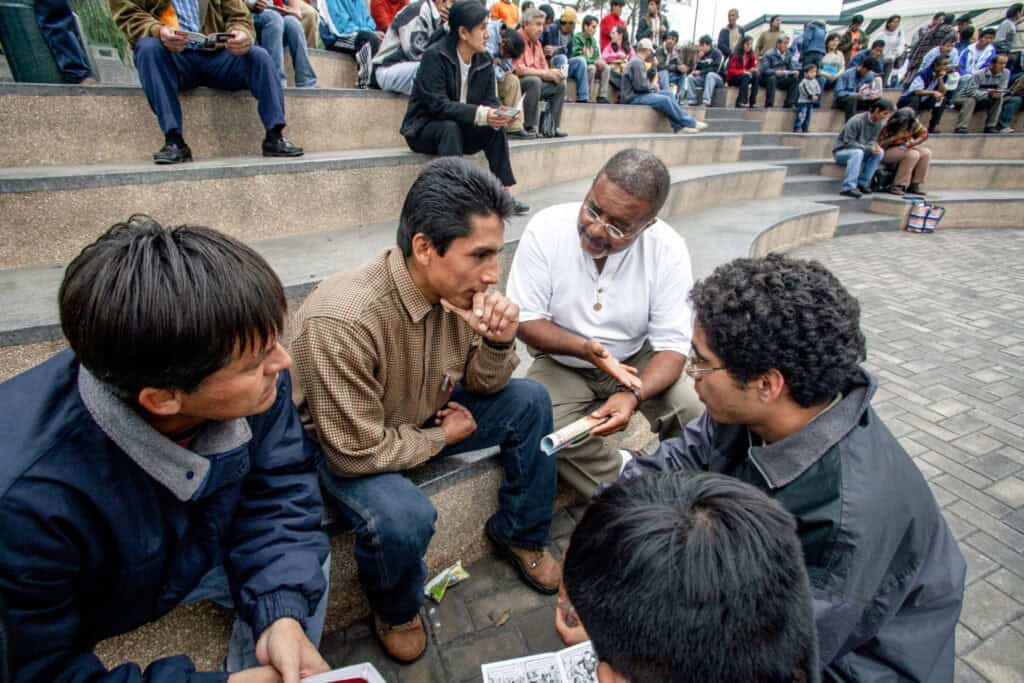
Perhaps the fastest-growing trend is the direct funding of national workers. National or local workers are people who have grown up in the ministry country. They do not have to move to another passport country for ministry. They may be pastors serving people from their own culture or cross-cultural missionaries sent by national churches to other regions of their own country.
There is a growing non-Western missions force. Missions is no longer from the West to the rest but from everywhere to everywhere. Missionaries from all over the globe are traveling all over the globe. India, South Korea, Brazil, and Nigeria are leading the way in this emerging missions movement.[ix]
A growing literature on partnership between the West and the rest has developed.[x] Furthermore, a great deal of attention has been given to the dangers of paternalism.[xi] All these emphasize mutuality—a relationship where each side gives and receives. Western Christians are growing in their awareness of the hazards of coming into a new situation, thinking they have all the answers. They are learning to rely on national partners to guide them to help in useful ways. At the same time, advocates such as K. P. Yohannan urge Western donors simply to fund Asian missionaries because they are cheaper and more effective.[xii] Yet, this issue cannot be reduced to cost comparison alone. The sending mandate of the Great Commission still applies to every nation. It must also be acknowledged that much more needs to be learned before effective partnerships become the norm.
There are a number of reasons why supporting nationals is attractive, both on the personnel and economic sides.
Local workers usually live at the economic level of their neighbors. A Western missionary family may need tens of thousands of dollars annually to cover travel, education, and healthcare. A national worker may require only a fraction of that. From a purely financial standpoint, a church can support several national evangelists for the cost of one expatriate.
National workers typically know the languages, customs, and social cues of their context. They often have natural networks for evangelism and discipleship, and church-planting experience. Their churches may look and feel indigenous from the start, avoiding the foreign religion stigma that sometimes hampers expatriate work.
Despite these positive elements, significant challenges remain for this strategy. Some of these have to do with the supporting side, and others with the receivers.
The Great Commission belongs to the entire global church. Outsourcing obedience, meaning treating missions like a project that can be “paid for” elsewhere, risks reducing mission to economics rather than a command for all Christians. When a congregation sends its own members, it invests not only money but prayer, friendship, and accountability. Churches that only write checks may find their passion for global mission wanes over time.
When funded from outside, fluency in the donors’ or recipients’ language can make communication and accountability difficult. Lack of language or contextual understanding may mask inexperience of those receiving funding or, sometimes, even deception. The most effective local leaders may be too busy, or too humble, to court outside donors. Careful, on-the-ground evaluation by those who understand the context is essential. Cross-cultural communication, financial transparency, and shared governance are complex.
Outside funding can unintentionally discourage local giving. It may also create artificial roles that vanish when foreign support ends. Without a clear plan for self-sufficiency, well-meaning gifts can hinder the growth of mature, resilient churches.
A general conclusion, both for those in favor and those skeptical, is that external funding is complicated. It involves so many issues besides finances, including cultural differences, leadership, language, use of money, accountability, power dynamics, and intercultural communication.
Despite the challenges, the mission pastors I interviewed described many positive experiences. In each case, strong relationships were the key. One claimed they had success because the partners were seen as “part of the[ir local] church.” Another church had a long-standing relationship with a national leader before they decided to support his ministry financially. One mission leader repeatedly used the phrase “high return on investment” to describe their experience with a particular national ministry. While not diminishing the relationship aspect of their partnership, he did emphasize the fact that national workers were more cost-effective than expatriate missionaries.
All these churches envisioned national support as the primary component of their missions program. Each of these acknowledged that there might be a need for American missionaries, particularly in pioneering situations where appropriate national ministries don’t exist. Nevertheless, they wanted to give their primary attention to national ministries.
While stories of fruitful collaboration abound, so do sobering accounts of failure.
Recognizing these patterns can help churches avoid repeating them. Through a variety of factors, trust can easily be broken on both the donor and receiver sides.
Several churches have discovered, sometimes after years, that the national missionary they fully funded did not exist or had left the work long ago. Other foreign visitors have discovered, after the fact, that their expression of interest in a particular ministry has been understood to be a promise of future funding. Even when both sides profess partnership, financial dependence can give donors subtle (or not-so-subtle) control. This dynamic can breed quiet resentment and stunt the development of indigenous expressions of faith.
Further, although the vast majority of national workers serve with integrity, cases of embezzlement or diversion of funds do occur. Currencies fluctuate, record-keeping standards differ, and auditing practices may be unfamiliar or impractical. Donors’ expectations of detailed receipts can feel intrusive in cultures where cash economies dominate, and informal transactions are normal. When abuse is uncovered, through government or media investigation, or whistle-blowers, the resulting scandal can taint not only the local church but also the sending congregation and the broader missionary cause.
Perhaps the most subtle harm is the effect on local stewardship. If a congregation knows that a foreign donor will cover salaries or building projects, members may not see the need to give themselves. The influx of outside funds can unintentionally teach that mission is the responsibility of wealthy foreigners, undermining the very goal of a self-supporting, self-propagating church.
Reflections On Donor Experience from Interviewees
Lessons for Donors
So, what makes the difference between a good experience and a poor one? Daniel Rickett offers several suggestions for avoiding pitfalls in partnership. These pitfalls include: assuming you think alike, promising more than you can deliver, taking the road without a map, underestimating cultural differences, taking shortcuts, forgetting to develop self-reliance, and running a race with no end.[xiii]
According to respondents, several lessons stand out. None of them explicitly mentioned the literature on partnerships, but their observations generally conform to the literature. These do not necessarily completely line up with Rickett’s suggestions, but there are many similarities. It is interesting to note that this is not just an American issue. Churches in other wealthy countries are dealing with some of the same challenges.
Clear lines of communication are the thread that runs through all the respondents’ answers. Clear communication is the basis for trusting relationships. Both partners need to be aware of the communication pitfalls that can arise. The expectations of each partner’s role should be made clear. Who makes ministry decisions? Who has ultimate control of money? Unexplored, unfulfilled expectations can lead to disappointments and cause relationships to crumble.
Do not be the sole source of funding, and don’t have one project be your entire missions emphasis. Diversify your missions giving. One mission leader with relationships with many churches observed that several smaller churches tried to support nationals without going through mission agencies, with little success. Some of those churches no longer exist, leaving their partners without the support that had been promised.
Recognize and understand cultural differences pertaining to leadership, community, and the use of money. It is common for Western donors to assume that their standards for accountability, bookkeeping, family relationships, and leadership are the same everywhere. They then become frustrated when their partners don’t see those things in the same way. They are tempted to frame those differences as matters of integrity, rather than differences of culture.
Develop true partnerships in which the donor church and national organization both bring significant value to the relationship. The quest for mutuality probably needs to begin with the donor, as receivers are often intimidated by the power of the donor or fearful that their desire for a voice will cause them to lose support. Donors need to be clear that they see the partnership as a true two-way relationship. It’s not always easy. Paternalism can be a temptation for donors from any background.
One way to build trusting relationships is by having people on boards (something Yohannan vehemently opposed[xiv]). Regular short-term mission trips can keep home church people involved. Scandinavian churches have supported workers from Central and Eastern Europe, even when the Scandinavian churches stopped sending missionaries themselves.
Partner with national leaders of proven integrity. It may take time to find these people, since they might not be the ones who are the most immediately attractive to donors. Of course, this applies to donors as well. Donors need not promise more than they can deliver. They also need to hold their power loosely.
Avoid direct support of individuals in favor of well-run agencies and churches with clear accountability structures. A respondent from Singapore mentioned they support students from other countries with scholarships to study at a bible college, but not when they return to their home countries. They feel the students’ own churches should support them.
Have an exit strategy. Don’t start an open-ended commitment. Make sure all parties are clear on when the partnership should come to an end. All parties should be clear about what they want to see happen through the partnership. Those who do not know when to leave are set up for disappointment.
The bottom line for all these mission leaders is that it is important to take the time to build relationships. Don’t rush in to establish partnerships with those national workers who are the most competent in English, or who promote themselves well. Take the time to find partners with integrity who can learn to cross cultures, just as the donors need to.
Lessons for National Workers
National workers receiving outside funds also carry responsibility for healthy funding relationships. Here are some things that local workers have done that helped foster positive experiences for donors.
They are careful to guard their integrity. They maintain meticulous records, even when donors do not require them. They model financial transparency for the local church and teach biblical stewardship. Their example may be as formative as their preaching.
They prioritize local ownership. Whenever possible, members of the new church or ministry are encouraged to give, however modestly, toward its own workers and facilities. They celebrate each step toward self-support and publicly recognize local generosity.
They communicate proactively. They do not wait for supporters to request updates, sharing both successes and setbacks honestly. Regular storytelling—through newsletters, audio messages, or in-person reports—builds trust and deepens the donor church’s spiritual investment.
They embrace mutuality. They remember that partnership is two-way. They invite prayer, insight, and even correction from their supporters, and offer their own gifts in return. Many national workers underestimate how much their experiences can bless and instruct the donor congregation.
They prepare for change. Economic fluctuations, political upheavals, or leadership transitions can suddenly alter funding streams. They maintain a personal emergency fund and plan for lean seasons. A ministry built entirely on outside income is a fragile ministry.
Into the Future?
Supporting national workers can indeed accelerate the spread of the gospel, but it demands humility, careful discernment, and deep relationship.
Believers from every continent are crossing borders in every direction. The question is not foreign missionaries or national workers, but how can God’s global people best collaborate for the sake of the nations?
Cost comparisons, though important, cannot determine obedience. The same God who sustained Moravian artisans, Jesuit scholars, and Baptist cobblers can provide for Brazilians in the Middle East, Nigerians in Europe, and Americans in Asia.
Wise churches will therefore continue to send their own missionaries, generously support partners in other contexts, and cultivate relationships marked by mutual accountability and shared vision. Funding mission will always be complex, but the Lord of the harvest invites us to trust him to supply every need.
AI declaration
AI tools were used to help clarify ideas for significantly shortening a longer paper. However, none were used for writing the actual content of the article.
[i] “Let every apostle who comes to you be received as the Lord. But he shall not remain more than one day; or two days, if there’s a need. But if he remains three days, he is a false prophet. And when the apostle goes away, let him take nothing but bread until he lodges. If he asks for money, he is a false prophet.” (Didache 11)
[ii]Andrews F. Walls, The Missionary Movement in Christian History: Studies in the Transmission of Faith (Orbis Books, 1996), 4; Thomas Cahill, How the Irish Saved Civilization: The Untold Story of Ireland’s Heroic Role from the Fall of Rome to the Rise of Medieval Europe (Anchor Books, 1995), chapter 6; Richard Fletcher, The Barbarian Conversion: From Paganism to Christianity (Henry Holt, 1997).
[iii] Ronnie Po-chia Hsia, “Jesuit Foreign Missions. A Historiographical Essay,” Journal of Jesuit Studies 1, no. 1 (2014): 47–65.
[iv] Dale T. Irvin and Scott W. Sunquist, History of the World Christian Movement, Vol. II: Modern Christianity from 1452–1800 (Orbis Books, 2012).
[v] William Carey, An Enquiry into the Obligations of Christians to Use Means for the Conversion of the Heathens. https://www.gutenberg.org/cache/epub/11449/pg11449-images.html; Dana L. Robert, Christian Mission: How Christianity Became a World Religion (Wiley-Blackwell, 2009), 45.
[vi] Walls, The Missionary Movement, 252-254; Klaus Fiedler, The Story of Faith Missions: From Hudson Taylor to Present Day Africa (Regnum, 1994).
[vii] W. R. Shenk, “Rufus Anderson and Henry Venn: A Special Relationship?” International Bulletin of Missionary Research 5, no. 4 (1981): 168–172; Roland Allen, Missionary Methods: St. Paul’s or Ours? (Robert Scott, 1912).
[viii] David G. Dawson, “Funding Mission in the Early Twentieth Century,” International Bulletin of Missionary Research 24, no. 4 (October 2000): 155–58.
[ix] See the “State of the Great Commission,” https://lausanne.org/report.
[x] E.g., Mary Lederleitner, Cross-Cultural Partnerships: Navigating the Complexities of Money and Mission (IVP, 2010); Daniel Rickett and Dotsey Welliver, eds. Supporting Indigenous Ministries: With Selected Readings (Billy Graham Center, 1997); William D. Taylor, ed., Kingdom Partnerships for Synergy in Missions (William Carey Library, 1994).
[xi] Steve Corbett and Brian Fikkert, When Helping Hurts: How to Alleviate Poverty without Hurting the Poor … and Yourself (Moody Publishers, 2009); Robert D. Lupton, Toxic Charity: How Churches and Charities Hurt Those They Help, And How to Reverse It (HarperOne, 2011); Glen Schwartz, When Charity Destroys Dignity: Overcoming Unhealthy Dependency in the Christian Movement (World Mission Associates, 2007).
[xii] K.P. Yohannan, Revolution in World Missions (Creation House, 1992).
[xiii] Daniel Rickett, Building Strategic Relationships: A Practical Guide to Partnering with Non-Western Missions, 3rd ed. (Stem Press, 2003).
[xiv] Yohannan, Revolution in World Missions, 238.

Scott Klingsmith is a global training specialist with WorldVenture. He taught intercultural ministry and church history at Denver Seminary for fifteen years, following twenty years in theological and missiological education in Central and Eastern Europe. He’s married to Chery and has three married children and eight grandchildren.
EMQ, Volume 62, Issue 2. Copyright © 2026 by Missio Nexus. All rights reserved. Not to be reproduced or copied in any form without written permission from Missio Nexus. Email: [email protected].
 EMQ ArticleFive Questions about Disciples and Disciple MakingJuly 15, 2026
 EMQ ArticleReframing Cross-Cultural Discipleship around Allegiance: Promoting Peace, Reconciliation, and Freedom from FearJuly 15, 2026
 EMQ ArticleBeing Among the Lost: Discipleship Must Move Back into the World of the UnreachedJuly 15, 2026