Toward a Wider View of Healing Missions
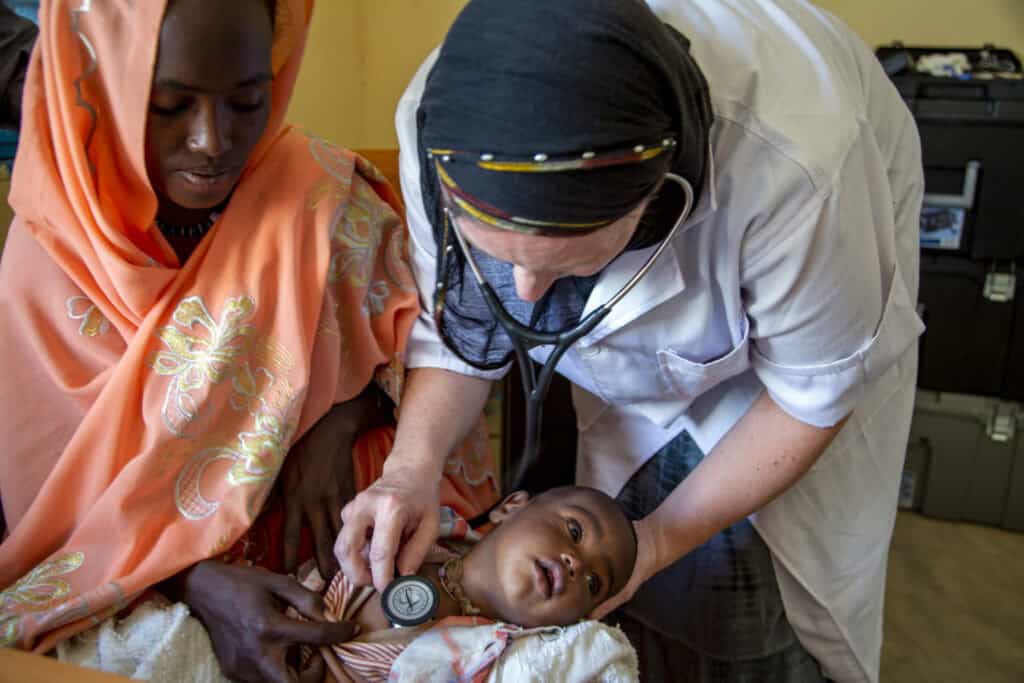
By Jim Ritchie | Healthcare missions suffers from a dichotomy of purpose. Is medicine alone an adequate motive as a ministry of compassion? Or are we wasting effort and money on the temporal body when we should be concentrating on the eternal soul? We need a broader strategic theology of healing missions. Might we find one that includes a wider spirituality of healing, including Hiebert’s “excluded middle?”
EMQ » April – May 2026 » Volume 62 Issue 2
Summary: Healthcare missions suffers from a dichotomy of purpose. Is medicine alone an adequate motive as a ministry of compassion? Or are we wasting effort and money on the temporal body when we should be concentrating on the eternal soul? We need a broader strategic theology of healing missions. Might we find one that includes a wider spirituality of healing, including Hiebert’s “excluded middle?”
By Jim Ritchie
One day, early in our first term at Chogoria Mission Hospital, I was rounding on our medicine ward with one of our chaplains, a Kenyan called Eliphas Mutegi. I was glad to have his spiritual and cultural mentorship on rounds. Eliphas is an excellent nurse and also a fine man of God. He left the higher pay of nursing to become a hospital chaplain. He is an unusual Kenyan who speaks very directly. Most Kenyans are indirect and gentle if they have a rebuke. Eliphas, not so much. I told him, “I want to invite the patients to pray, but I don’t want to ignore their vulnerability. I have gray hair, which they respect, and I am a Westerner, which they respect, and I am the doctor, and they are the patient. I know there is a perceived power difference, which I do not want to use improperly. So how can I invite them to pray without them feeling compelled?”
Eliphas said, “You Americans are so afraid.”
He continued, “We Africans know that there is a spiritual component to illness, and we want to see it dealt with. It’s you people who seem to have forgotten about that. If you, as the Christian doctor, don’t deal with the spiritual component of the illness, when the patients leave the hospital, many of them will go see mganga, the witch doctor, to get these spiritual issues dealt with. Do not fail to pray with your patients. And, Missionary, you really shouldn’t be asking me questions like that.” As I said, Eliphas was direct.
The problem is, I had no idea what he was talking about. What was this “spiritual component to illness” that everyone but me seemed to understand? There clearly was a gap in my understanding. And so Eliphas’s challenge was a push to understand that gap and explore a deeper understanding of healing missions, and how we can join the Lord in the ways he heals.
A Historical Debate About Our Primary Goal
The gap in understanding about the spiritual component of illness shows up in debates in the Western church about our purpose in healthcare missions. What is our goal in taking medicine to the nations? This debate has been going on since the origin of Christian medicine. It was discussed by Basil, the Bishop of Cappadocia in the fourth century AD,[i] and raised again by the founders of modern healthcare missions.[ii] The debate continues in many current sending agencies.
Some Christians contend that medicine for the material body alone is a sufficient goal for healthcare missions, even if nothing overtly spiritual is done. They argue that bringing relief to people who need it is “good enough.”
Other Christians believe that because the body is temporal and the soul is eternal, we should always prioritize the soul. Thus, healthcare’s primary value in missions is creating opportunities for sharing the gospel. Sometimes we hear new missionaries say, “I am only planning to work a couple of days at the hospital because I want to spend the rest of my time doing ministry.” That position endorses the idea that medicine is for the body, and the real work of ministry is for the soul.
This tension has perplexed Western Christians for almost two thousand years. Which should be our emphasis in healthcare missions – the body or the soul?
Swelling and the Supernatural
On a different day, Eliphas and I were doing medical rounds again. I introduced him to a man whom we had admitted the day before. He was a young man who had significant edema, or swelling. I told Eliphas we were working him up for heart failure or kidney failure, both of which were very common in our patients.
Eliphas chatted with the man in the local language. Then he told me, “This fellow says that he has been cursed by his in-laws because he hasn’t been keeping up with dowry payments.”
I was rather uncomfortable with the matter-of-factness of his statement. I was wondering whether our Christian chaplain believed some sort of syncretism, blending Christianity with some of the local animistic beliefs. With a bit of judgmentalism, I said, “Well, I will be working him up for heart failure and kidney failure.”
Eliphas looked at me and said, “You don’t believe in curses, do you?”
I responded, “That really hasn’t been my practice or my experience.”
His eyes held a rebuke as he replied, “You need to read your Bible more closely.”
Immediately, I realized he was very right. Throughout Scripture, curses and evil spirits are identified as the source of physical problems and are treated with utmost seriousness. Jesus certainly believed that spirits can cause illness.
A colleague who has lived and worked in Southeast Asia for many years told me, “When Americans come here, they think that spirits and curses are a superstition. And that doesn’t last very long. Because the manifestations of the spirits here are in your face. In the US, it seems as if the spirits are hiding, working behind the scenes. Not here. The spirits are doing things in the open here to keep people in fear. Many of our patients come to this hospital to find out if the Christian God has any power over the spirits. And he is happy to demonstrate that power. Miracles of healing here are simply commonplace. Not so much that we can predict or promise them, but the Lord shows his power often.”
Personally, I don’t feel confident or experienced in the realm of dealing with spirits and curses. And to be clear, I do think that some beliefs about such things are superstition. On the other hand, there are some experiences that do not fit with what I was brought up to believe.
The Excluded Middle
Paul Hiebert grew up as a missionary kid in India, later serving as a missionary there before returning to the US and becoming “arguably the world’s leading missiological anthropologist.”[iii] He wrote, in 1982, about the concept of the “Excluded Middle.” Hiebert said that we, in the West, tend to divide the body and the spirit, the material and the supernatural. The supernatural, or spirit realm, is with God in heaven and rarely touches the material world, which we interact with on a day-by-day basis. But most of the people in the world don’t divide the spiritual and material realms. For them, spiritual things are encountered in this physical world on a regular basis. Hiebert referred to this recognition of spirits present in everyday life as an excluded middle, or vacuum, in the Western worldview. While for Westerners, curses, blessings, and spirit beings are not part of normal life, this is not the case for most people of the world. Their understanding of the world includes the everyday experience of blessings, curses, spirits, and their manifestations in the physical body.[iv]
My Western mindset was apparent in my conversation with Eliphas regarding the swollen man and the curse. I argued with him, “But his laboratory tests are abnormal.”
Eliphas said. “You don’t think a curse can cause lab tests to be abnormal? Look at the man and his swelling. That swelling came from some mechanism. Of course, a curse can have physical changes. This isn’t fantasy.” I had trouble conceptualizing that the spiritual could really change the material. Eliphas had no such difficulty.
I learned that the cultural beliefs of most people we treat in mission hospitals absolutely integrate the material and the spiritual. This “excluded middle” is part of what Eliphas meant when he spoke of the spiritual component of illness. He taught me to fight the enemy on both material and spiritual fronts. We treated this man’s renal failure medicinally, prayed against the curse, and encouraged the patient to make things right with his in-laws. And the renal failure cleared. Which of those elements was the most important?
A Logical Fallacy
Let’s return to the debate between medicine for medicine’s sake and medicine as only useful as a magnet for people to hear the gospel. This debate is actually an either/or fallacy, or a false dichotomy. The two alternatives are presented as if there is only a choice between those two alternatives. It assumes a separation of body and soul. Many of us in healthcare missions have been embracing and endorsing this logical (and spiritual) fallacy for years. However, both positions are valid, and both are biblical.
Medicine is a wonderful ministry on its own. The Good Samaritan[v] acted like a paramedic. He found the man injured on the side of the road, provided first-century medicine (oil, wine, and bandaging), put the man on his transport vehicle, and took him to the place of ongoing care. Jesus did not say, “The Samaritan stopped and prayed, and the man was healed or led to salvation.” Instead, Jesus, a miracle worker, described medical care as an exemplary way to love your neighbor.
Speaking about a day of judgment, Jesus said, “I was hungry and you gave me something to eat… I needed clothes and you clothed me, I was sick and you looked after me.”[vi] These are ministries of bodily compassion. Jesus did not include in this list: “I was spiritually destitute and you led me to salvation.” Jesus clearly affirmed that the bodily ministry of medicine has tremendous value.
The second half of the debate is also true. Medicine is a powerful magnet that draws people to hear the gospel. When we are sick or our family members are sick, we are spiritually sensitive. We often ask questions of God about why this may have happened. We are internally compelled to pray. In many churches, prayer requests are predominantly about illnesses and surgery.
Many patients who would never darken the door of the church, or seek out a pastor or missionary, will go to a mission hospital to be treated. And many of them are led to eternal salvation. Jesus often healed, then preached, and taught the disciples to do the same.[vii] Healing was a materially beneficial sign that drew people to deeper truth.
But the ministry of medicine isn’t limited to these two options. Another misleading aspect of false dichotomy is the suggestion that only two options exist. In fact, other options may be valid. Inour case, the ministry of medicine can extend across the vacuum of the Western excluded middle that Hiebert described.
The Old Farmer’s Lesson
One Saturday, I was visiting patients on the medicine ward for the team that had been admitting during the week. The interns told me about our next patient, an older fellow, a farmer. He had been advised the day before that he had an advanced cancer which was beyond surgical cure. There were no affordable treatment options for him other than palliative care.
When we approached his bed, he was reading his Bible in the local language.
We exchanged greetings and pleasantries. Then I said, “I understand you received some news yesterday.”
He responded. “Yes. What do you recommend?”
I am embarrassed to say that I was caught flat-footed. I felt impotent. We really had nothing to offer him. I fumbled around and offered a few temporary treatment options.
Then he stopped me and said, “The Lord Jesus has met with me, and I know where I am going. Do nothing to delay my joy.” Then he dismissed us and returned to his Bible.
I stood there, the missionary who had just been schooled by an old farmer. I thought he would be afraid of death. I thought I had nothing to offer him. I thought we had failed him. Instead, he taught me about the Christian’s approach to the end of this earthly life. He, like the Apostle Paul, felt that “to live is Christ and to die is gain.”[viii] He wasn’t afraid of death. He was ready for it. And I began to understand that even in the face of a fatal diagnosis, we have a powerful spiritual ministry to patients and their families. I thought I had nothing to offer that man. He showed me that at the end of life, Jesus can offer joy.
That’s kingdom living. It prospers in the space where the body and the spiritual are intertwined.
Healing Without Bodily Restoration
Even when bodily restoration doesn’t happen, we can join with the Lord in healing. One day, our chaplains asked my wife Martha to come speak with a woman who had lost her unborn baby late in pregnancy. Martha had no idea what she would say to comfort a Kenyan woman in that situation. But she proceeded to the maternity ward.
The woman told Martha, “I don’t understand. Has God abandoned me? I have had several miscarriages. I told God that if he would give me a son, I would name him Immanuel. And he gave me a son. And I named him Immanuel. But now he is dead, and I don’t know what to do.”
Martha had no idea what to say, but prayed, “Lord please help me!”
God told her, “I had a son named Immanuel.”
So, Martha simply repeated to the lady, “God had a son named Immanuel.”
The woman’s countenance brightened immediately. She said, “He did! He had a son named Immanuel! And oh, he died, too!” That communication of the Holy Spirit, through Martha, affirmed to this woman that God had notabandoned her, but instead understood and shared her pain. That interaction entered into a heartbreaking situation and made it also one of deep joy. That joy was durable. Martha encountered the lady weeks later, after a Caesarean section, an infection, and a prolonged hospital stay. The joy about her shared relationship with God’s own suffering remained. There was healing. That healing didn’t restore earthly life to her baby but did heal the lady’s soul.
We can help people with spirits, curses, and profound guidance when facing death. We can also facilitate discovery of God’s purposes in suffering. Maybe the excluded middle can instead become the explored middle. As we explorethis middle space where the spiritual and physical intertwine, sometimes we get to see the Lord do something really remarkable.
The Fellow with The Pessimistic Prognosis
The clinical team had admitted a fellow to the ward who was very ill, comatose, and in need of an ICU that we didn’t have. We treated him as best we could, but didn’t expect him to live. Our chaplains, Polline, Nancy, and Trizer, knew that death is a part of life, and they knew how to pray accordingly. But with this gent, they felt strongly led to pray for his recovery. They prayed at his bedside every day as his condition deteriorated. One day, the nurses told them that he was still breathing but they couldn’t find a pulse, so the end was near. But they still prayed for his recovery. Then, surprisingly, he began to improve in ways the medical team couldn’t fully explain. Over days, he improved until one day the chaplains came to the ward and were thrilled to find him awake.
As the chaplains began to introduce themselves, the man replied, “No, there is no need for that. I know exactly who you are. I have heard your prayers. I heard them from far away. One time, I was to enter the Holy Place, and I was told, ‘No, you are not to enter, because those ones are praying for you. You need to wake up.’ And so here I am.”
Interestingly, this fellow didn’t remember hearing the conversations of the ward team. He only remembered hearing the prayers of the chaplains. (And the conversation at the Holy Place.)
This reminds us that prayer is not just of the mouth and the ears, but also of the spirit. Praying for and with the comatose is yet another opportunity for ministry in the middle.
Medicine For Medicine’s Sake
Let’s return to the view that “medicine for medicine’s sake is ‘good enough.’” Sometimes we are comfortable with this and too quick to accept that option alone. That was certainly my position when we first arrived in Kenya. Perhaps we would be wise to consider how we differ from medics from a secular organization. Or, more importantly, how our patients would say we are different.
Once, during a weekly meeting, one of our chaplains said to me, “Daktari [Swahili for “doctor”], many of our patients come here to Chogoria to find out if the Christian God has any power. And they watch you to see what you think. When you’re at the bedside, and you speak only of the science, they think that you think that’s where the power is.”
Immediately, I was ashamed to realize that I had become like King Asa’s physicians,[ix] encouraging the patients to seek the science of medicine and not encouraging them to seek the Lord. I had not remembered Eliphas’s lesson. I was functioning no differently from a medic in a secular organization when I could have helped our patients enter into much more profound healing. Medicine for medicine’s sake has its place, but perhaps that place is smaller than the broader place God invites us into.
Healing in the Middle
I went to Chogoria to teach and provide good medicine, but I went with no perception of how spiritual realities interact with physical bodies. There’s a lot of healing to be done at the intersection of bodies and the spirit world. We can help patients not to fear death, even to have joy at the end. When healing doesn’t come, we can help our patients see the spiritual growth that God has for them, drawing on the wisdom of local Christians to deal with their understanding of non-material causes for illness. I no longer dismiss spirits and curses as superstition. There is an old medical adage: if you don’t make the diagnosis, you don’t know how to treat. Learning what fills the excluded middle space, the spiritual realities that populate and affect local people’s lives, is an important part of medical practice.
Instead of separating the material body from the spirit, we can think of ways we can join God in healing, perhaps in many ways, at the same time, with the same patient.
And I think we all need an Eliphas, who will open our eyes to our blindnesses. Eliphas was right when he said I was afraid. I was afraid, and afraid of the wrong thing. I shouldn’t have been afraid of entering into spiritual talk with my patients. I should have been afraid of missing the profound opportunity to explore the ways God allows us to work with him in healing.
Friends, no one need leave the mission hospital to engage in ministry! The mission hospital can be an intense place of ministry. Healing missions can be a truly holistic ministry. We engage body, mind, and spirit in ways few others can. In this space, we have the opportunity to reflect the love and compassion of the greatest healer. May he grant us courage to not be afraid, as Eliphas said, and instead to delight in the wonderful spiritual adventure and mutual blessing of the ministry of healing.
[i] Basil the Great, The Complete Works of Saint Basil, Cross-linked to the Bible (public domain), “The Long Rules,” Q. 55, Kindle edition
[ii] Christoffer H. Grundmann, Sent to Heal! Emergence and Development of Medical Missions (University Press of America, Inc., 2005), 59–71.
[iii] Robert J. Priest, “Paul Hiebert: A Life Remembered,” Books & Culture: A Christian Review, September/October 2007, https://www.booksandculture.com/articles/2007/sepoct/9.9.html.
[iv] Paul G. Hiebert, “The Flaw of the Excluded Middle,” Missiology: An International Review 10, no. 1 (1982): 35–47.
[v] Luke 10:25–37.
[vi] Matthew 25:31–46.
[vii] Luke 9:11; Matthew 4:23–25; Matthew 9:35; Mark 6:12.
[viii] Philippians 1:21.
[ix] 2 Chronicles 16:12.
Jim Ritchie After 25 years as a physician in the U.S. Navy, Jim served for six years as a medical missionary in Chogoria, Kenya. Afterwards, he served with the MedSend Longevity Project, the World Medical Mission Post-Residency Program, and with the MedTeam at Alongside Counseling. He loves helping healthcare missionaries and their teams thrive in the challenging context of cross-cultural medicine and exploring the astounding spiritual power of healing missions.
The opinions expressed in this article are those of the author and do not necessarily represent those of Samaritan’s Purse, World Medical Mission, Alongside Inc., or any other individual. The author is indebted to Andrew Brown for his editorial assistance.
EMQ, Volume 62, Issue 2. Copyright © 2026 by Missio Nexus. All rights reserved. Not to be reproduced or copied in any form without written permission from Missio Nexus. Email: [email protected].
 EMQ ArticleFive Questions about Disciples and Disciple MakingJuly 15, 2026
 EMQ ArticleReframing Cross-Cultural Discipleship around Allegiance: Promoting Peace, Reconciliation, and Freedom from FearJuly 15, 2026
 EMQ ArticleBeing Among the Lost: Discipleship Must Move Back into the World of the UnreachedJuly 15, 2026