Conversational Evangelism Among Diaspora from Unreached People Groups
By Bill Babione | Conversational evangelism among diaspora from unreached people groups, such as the Ahiska Turks, is most effective when it is relational and intentional. Building genuine friendships, engaging in two-way cultural exchange, and purposefully creating opportunities for dialogue are key.
EMQ » Jan – April 2026 » Volume 62 Issue 1
Summary: Conversational evangelism among diaspora from unreached people groups, such as the Ahiska Turks, is most effective when it is relational and intentional. Building genuine friendships, engaging in two-way cultural exchange, and purposefully creating opportunities for dialogue are key. Sharing faith through authentic relationships and hospitality opens doors for meaningful conversations about Christianity, especially within tightly knit immigrant communities. Christians are encouraged to prepare for these opportunities by being welcoming, adaptable, and proactive in connecting with their new neighbors.
By Bill Babione
“Could I learn about Christianity from you? I have only ever learned about Christianity from other Muslims.” These words came from my new friend, Halil,[i] at the end of a wonderful evening of food and conversation in his home. Halil is an Ahiska Turk.[ii] Ahiska Turks are a unique community of immigrants that have experienced forced relocation multiple times over the past 75 years. Halil is a friendly, hospitable, gregarious, and thoughtful man in his mid-’60s. He has suffered much but demonstrates great resilience.
I first met Halil at a local Turkish food festival. He is one of the leaders of this immigrant community and another person I met at the “tea table” was anxious to introduce me to him. These food festivals are one of the ways the Ahiska Turkish community seeks to be seen, known, and trusted by the broader Dayton community.
Halil lived in a downtrodden part of Dayton. He had worked hard to fix up his home. It was simple but nice. He kept a copy of the Qur’an on the living room coffee table, where we sat for the first thirty minutes of my visit, until dinner was ready. There was a prayer carpet rolled up and a large picture of a mosque in Mecca.
His wife was not there. He said she was visiting their daughters and grandchildren in Turkey. In addition to Halil, his seventeen-year-old grandson, and Özgün, the “tea table guy,” also joined us. Both the grandson and Özgün served as translators when needed. The food was khinkali, burek, and baklava – I believe mainly left over from the Turkish Food Festival. Interestingly, even though Halil invited me for dinner, he was fasting. So, only the grandson, Özgün, and I enjoyed the meal. This did give a chance for Halil to tell his story.
I listened to his story for around two hours, interjecting questions. I heard about his family and work. I learned that he was a national table tennis champion of Uzbekistan as a youth. I also learned about the pain of being forced to relocate to Russia, and then later to the United States. I learned how deeply important his faith is to him. When I asked how he dealt with so much hurt and pain he replied, “We believe that things happen for a purpose. Even if it’s happening because of evil people, we think God is testing us or using it somehow to change us.” He had a very strong conviction about fate. For Halil, this meant that all things were to be seen as written by Allah and accepted as his will.
After those two hours of sharing, he felt embarrassed that he had not asked me much about myself. I shared briefly about myself, leaving my story “for another time.” But I added, “Halil, what I would most want you to know about me is that I am a follower of Jesus, and my faith is very important to me.” This transparency about the importance of faith in God was met with enthusiasm, leading to the request to learn about Christianity. To his request I replied, “Of course – it would be my honor.” By the time I arrived home, I had an email from him with his top 5 questions related to Christianity. Most of these were regarding the Christian understanding of fasting. These initial questions led to a series of email interactions over the next few weeks. Eventually, Halil, along with Özgün and his family, visited our home and we continued the conversation.
Halil, Özgün, and I have genuinely become friends. Our friendship includes open conversation about what matters most to us – our faith. As a result, I have had the privilege of talking about Jesus, opening the Scriptures, and explaining the gospel multiple times.
The purpose of this article is to help equip Christians to understand the importance and practices of a conversational approach to evangelism among diaspora from unreached people groups (DUPG) like Halil and the Ahiska Turkish community. I will highlight three principles of conversational evangelism among Ahiska Turks and other DUPG. Conversational evangelism should be: 1) Relational; 2) Intercultural; and 3) Intentional.
Conversational Evangelism
Conversational evangelism is the communication of the gospel message in the context of dialogue. It occurs between individuals who approach one another with friendliness and goodwill. It implies a highly relational environment. Beliefs are discussed in a personalized manner, allowing for specific questions and responses. This context provides a sense of fellowship through the experience of heartfelt exchange of ideas and convictions.
I believe this is what the Apostle Paul was requesting prayer for in Colossians 4:3-6:
And pray for us, too, that God may open a door for our message, so that we may proclaim the mystery of Christ, for which I am in chains. Pray that I may proclaim it clearly, as I should. Be wise in the way you act toward outsiders; make the most of every opportunity. Let your conversation be always full of grace, seasoned with salt, so that you may know how to answer everyone. (NIV)
He requested prayer that God “open a door” for the message and then proceeded to speak of how one should go about sharing that message when the door is opened. He emphasized “conversation” that is “full of grace, seasoned with salt.” He said that this type of interaction is needed to “know how to answer everyone.” James Dunn captures its essence:
The picture here envisages opportunities for lively interchanges with non-Christians on topics and in a style which could be expected to find a positive resonance with the conversation partners. It would be conversation which reflects the attractiveness of character displayed above all by Christ. Such conversations would regularly and quite naturally raise opportunities to bear more specific Christian witness – not as something artificially added on to a “secular” conversation, nor requiring a special language or manner of speaking, but as a part of a typical exchange of opinions and ideas.[iii]
Relational
Many American evangelicals are fearful of immigrants and would prefer to see them deported.[iv] In addition, even those that are motivated to reach out to DUPGs, tend to lack cross-cultural training or understanding. Their approaches to witnessing are culturally uninformed, tending to be non-relational, and highly programmatic. Samuel Escobar warns of the temptation to depersonalize the unreached, viewing them as “an evangelistic target.[v]
In contrast, people I interviewed who serve among DUPGs here in the US made the following comments about the importance of being relational:
- “It is all about relationship building!”
- “Absolute most important thing!”
- “You can’t get anywhere gospel-related without relationship!”
- “Not just relational but highly relational!”
- “100% important!”
- “The most important thing!”
They stressed the need for gospel ministry among DUPGs based on dedicated, personal connections. Sharing the gospel through relationships communicates something essential about God’s relational nature and love for the world.
Two Directions of Relationship
Conversational evangelism is a relational environment where God, his messengers, and an audience (see Diagram 1) are in dynamic interaction with one another.
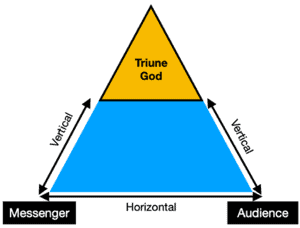
In this triad there are two relational directions, vertical and horizontal. These two relational directions are at work concurrently. Vertically, God works in his messengers. They need to abide in him (John 15:4-5) and follow his lead. It must be the “love of Christ … that constrains” his ambassadors. God is also at work in the lives of the audience. His messengers pray, seeking him for his work and Word to take root in their hearts and minds. Horizontally, there is a relationship between God’s messengers and unredeemed people. This relationship affects how the audience responds to God. Messengers must approach others as equals and with respect. They love them as neighbors, as they love themselves.
The emphasis here is a God-dependent approach marked by authentic, engaging conversations. This differs from friendship evangelism. As Mikeska states, “The careless use of ‘friendship evangelism’ tends to cheapen relationships to become a means to an end.”[vi]
Friendship evangelism aims to earn the status of friend before talking matters of faith. A relational approach means approaching people more authentically, sharing one’s life, including faith in Jesus from the outset.
In conversational evangelism the person is the context. As Aldrich states, “The relational model builds a context for meaning.”[vii] The fact that the vast majority of DUPGs are from highly collectivistic cultures only heightens the need for a relational context for them to consider the Christian faith. The relational context allows the messenger to prayerfully consider how to adapt, personalize, and explain the gospel, as the person responds to what they are hearing.
Jesus, the Word, “became flesh and dwelt among us.” (John 1:14) He came “full of grace and truth.” (John 1:17) Truth can be delivered in many forms, but grace comes through relational touch and presence. Richard Phillips writes, “Christian truth never involves merely a transfer of information but a personal relationship.”[viii] Being relationally connected with people reflects the good news that God has created them for a relationship with him.
Intercultural
Often, when we speak of cross-cultural ministry, we conceive it as one-directional. In an “intercultural” approach, the emphasis is on two-way giving and receiving. It is about wrapping your life up with the lives of others. It involves mutuality and reciprocity, two hallmarks of friendship in many cultures. Lingenfelter and Lingenfelter state:
In many two-thirds world cultures, a deep relationship does not begin until there is a debt and reciprocal obligation. We have found that one of the best ways to signal our desire for a deeper relationship is to ask others for help. For self-sufficient westerners, asking for help is much more difficult than giving it. By committing yourself to receive and to give, you signal a desire for a deep, supportive relationship.[ix]
Such two-way relationships go beyond the role of being a donor, helper, or benefactor. It involves interdependence, something that many of us find uncomfortable. This two-way relationship and culture-sharing are a fundamental part of communicating dignity and equality to others.
Going to Halil’s house was more uncomfortable for me than having him in my home. In his home I was the needy one. I felt less in control. I didn’t set the rules of engagement. I was entrusting myself to his care. Being in his home helped me to communicate that he had something to offer me. I sensed that he felt honored and dignified by my coming to his home. And certainly, I left feeling new appreciation of who he was and his cultural heritage. From that visit, a pathway to the gospel opened. And, operating on the principle of reciprocity, we then invited Halil, Özgün and their families to our home where the conversation continued.
From a biblical standpoint, I believe that the onus is on the Christian to initiate such interdependence by moving into the cultural context of those they are seeking to reach. In 1 Corinthians 9, Paul speaks of adapting to the many different groups of people he sought to reach with the gospel. He summarizes, “I have become all things to all people so that by all possible means I might save some.”[x] Paul sees the possibility of people being won to Christ in these communities. His path to this possibility was by choosing to become like them. As a servant of Christ, he surrendered his rights. His perspective could be well summarized: Being like Christ I become like you, that you might come to Christ.
Cho and Page call this “evangelism in weakness,”[xi] based on the example of Christ given in Philippians 2:5-7:
Have this mind among yourselves, which is yours in Christ Jesus, who, though he was in the form of God, did not count equality with God a thing to be grasped but emptied himself by taking the form of a servant.
This weakness significantly contrasts with Christians who avoid contact with those whose beliefs don’t align with theirs. It acknowledges that those outside of the faith have something to offer to Christians. It also affirms the deep dignity in every person created in the image of God. There has been an encouraging and helpful emphasis in recent years in many churches to create opportunities for belonging before believing for non-Christians. For many this can be a great way to test out Christianity prior to committing to personal faith in Christ. But the Ahiska, like most DUPGs, will not visit churches to experience this kind of belonging. What they need is for Christians to be willing to become part of the immigrant community. Cody Lorance captures this thought:
If they feel they feel that they are heard by me, if they feel they can give to me, and if they truly and deeply love me, then I am theirs – an insider to their community. This, in turn, means that I follow Jesus as one of them rather than as a foreigner. So, Jesus belongs to them.[xii]
Among the Ahiska, I do not know of any followers of Jesus. There is little openness to Christianity and great guardedness toward outsiders. How will they ever belong to Jesus? I believe the need is for followers of Jesus who will courageously find paths to belong, as a follower of Jesus, within their community. Christ and the gospel will need to be brought within their cultural setting, demonstrating to them that they can still be part of the Ahiska community while also believing in Christ.
One simple, yet profound, pathway toward this intercultural approach is to ensure our conversations are dialogues, not monologues. Intercultural, conversational evangelism is a two-way street with information traveling in both directions. There is reciprocity and mutuality in the exchange that dignifies the people and clarifies the content of the conversation. Severson powerfully summarizes the call to gospel dialogue:
It is, therefore, un-Christian to evade self-risking dialogue, for the God of Jesus Christ constantly initiates such dialogue, and does so with unmistakable care for the otherness of the ‘other.’ God as Trinity is decidedly extroverted, oriented toward the ‘other’ in faithful dialogue.[xiii]
Intentional
When considering intentionality, we are reminded of Christ’s declaring he came to “seek and to save the lost” (Luke 19:10). He is the Good Shepherd who leaves 99 sheep to find a single lost sheep. God is the ultimate initiator. People seeking to reach out to DUPGs are going to great lengths. They are moving into new school districts to take teaching jobs. They are re-routing their daily lives to new grocery stores, cafes, and restaurants. They are learning new languages while living in their home country. They are joining fitness clubs and learning new sports. They are attending cultural festivals. They are prayerfully, intentionally, putting themselves in a place where God might open a door.
Ahiska people intentionally moved to Dayton because they value being together as a community. They model the kind of dedication to one another that is essential for anyone wanting to connect with them. Most Ahiska live their days completely embedded in their own community. Many of them own their own businesses where other Ahiska work for them. They court and get married within the community. They worship together, celebrate holidays together, and organize their own community events and services.
With that in view, it is obvious that anyone who wants to influence this community will need to be intentional to develop opportunities. Prayerful intentionality creates opportunities for relational and intercultural conversations to take place. Certainly, hospitality will be one of the chief expressions of this intentionality. We can’t always rely on others to invite us, but they probably will if we invite them first. The offer of friendship and food in someone’s home speaks to the heart at a relational level like little else. These days, when it seems there are fewer means for public witness to Christ, hospitality shines bright. Mikeska comments:
When people don’t gather in droves for stadium crusades, or tarry long enough on the sidewalk to hear your Gospel spiel, what will you do? Where will you interact with the unbelieving about the things that matter most? Invite them to dinner.[xiv]
Obviously, the Bible has much to say on the topic of hospitality, particularly towards strangers and people in need (e.g., Deuteronomy 27:19, Psalm 146:9, Romans 12:13). The Scripture affirms the essential attitude of personal welcome that should surround the Christian’s witness. In the midst of welcome, there seems to be a heightened interaction between the host, the guest, and the Lord.
Conclusion
People’s geographical movement is a part of God’s sovereign purposes. The Apostle Paul, while on Mars Hill in Athens, stated:
From one man he made every nation of men, that they should inhabit the whole earth; and he determined the times set for them and the exact places where they should live. God did this so that men would seek him and perhaps reach out for him and find him, though he is not far from each one of us. (Acts 17:26-27 NIV)
Jehu Hanciles captured this idea when he stated:
The interface between human mobility and divine purposes in the biblical story is unmistakable and compelling… (there is) an inextricable link between migrant movement and the Missio Dei (the mission of God).[xv]
Vast numbers of people from groups currently classified as “unreached”[xvi] are migrating to locations where there are many Christians and churches. Most certainly, God has salvific intent in their migration. But are Christians ready to reach out to their new neighbors and share the good news of Christ with them in meaningful ways? Christians everywhere need to prepare themselves for conversational opportunities to share the good news. But to do so they need to be ready to be relational, intercultural, and intentional.
[i] All names in this article have been changed for confidentiality.
[ii] Ahiska Turks are also often identified as Meskhetian Turks. They originated from a region of, what is now, the Republic of Georgia. They were forcibly relocated by Stalin in 1944 to Uzbekistan. In 1989 many were relocated to the Krasnodar region of Russia prior to the breakup of the Soviet Union. In the mid-2000s around 17,000 were granted asylum in the United States. About 2500 now reside in the Dayton, Ohio area.
[iii] James D. G Dunn, The Epistles to the Colossians and to Philemon (Eerdmans, 1996), 267.
[iv] According to Robert Jones, “How Americans view immigrants, and what they want from immigration reform: Findings from the 2015 American values atlas,” March 29, 2016, Public Religion Research Institute, https://www.prri.org/research/poll-immigration-reform-views-on-immigrants/, “white evangelicals” are the highest-ranked religious grouping in the desire to see illegal immigrants “captured and deported.”
[v] Jared Looney, Crossroads of the Nations: Diaspora, Globalization and Evangelism (Urban Loft Publishers, 2015), 210.
[vi] Enoch Wan and Shane Mikeska, Engaging the Secular World through Life-on-Life Disciple-making in the British Context (Western Seminary Press, 2020), 45.
[vii] Joe Aldrich, Life-Style Evangelism, (Multnomah Press, 1983), 84.
[viii] Don Carson and Timothy Keller, eds., The Gospel as Center (Crossway, 2012), 37.
[ix] Judith Lingenfelter and Sherwood Lingenfelter, Teaching Cross-Culturally: An Incarnational Model for Learning and Teaching (Baker Academics, 2003), 119.
[x] 1 Corinthians 9:22
[xi] Eugene Cho and Samira Izadi Page, No Longer Strangers: Transforming Evangelism with Immigrant Communities (Eerdmans Publishing, 2021)
[xii] Enoch Wan, Diaspora Missiology: Theory, Methodology, and Practice, (Institute of Diaspora Studies, 2011) 283.
[xiii] Eric R. Severson, “Ethical Dialogue: Trinitarian Externality as a Pattern for Evangelism and Missions,” Wesleyan Theological Journal 38, no. 1 (2003), 110.
[xiii] Severson, “Ethical Dialogue: Trinitarian Externality as a Pattern for Evangelism and Missions,” 121.
[xiv] Wan and Mikeska, Engaging the Secular World through Life-on-Life Disciple-making in the British Context, 119.
[xv] Jehu J. Hanciles, Beyond Christendom: Globalization, African Migration, and the Transformation of the West (Orbis Books, 2008), 140. Cited by J. D. Payne, Strangers Next Door: Immigration, Migration, and Mission (InterVarsity Press, 2012), 85.
[xvi] There are varying definitions of the term “unreached people group.” In simple terms, as stated by Lausanne Committee on Global Evangelization in July 2011, an unreached people group is “an ethnic group without an indigenous, self-propagating Christian church movement.” IMB’s website, www.peoplegroups.org, defines it this way: “A people group is considered unreached (UPG) when there is no indigenous community of believing Christians able to engage this people group with church planting.”
Bill Babione is the global director of Athletes in Action (a Cru ministry), mentoring ministry leaders in over 90 countries. He served in Albania and Hungary for twenty-two years focusing on evangelism and discipleship. He has engaged in thousands of highly relational conversations about Jesus Christ with people from many backgrounds. He has a doctorate in intercultural studies from Western Seminary. He now lives in Xenia, Ohio with his wife Wini. He has three children.
EMQ, Volume 62, Issue 1. Copyright © 2026 by Missio Nexus. All rights reserved. Not to be reproduced or copied in any form without written permission from Missio Nexus. Email: [email protected].